Showing posts with label christianity. Show all posts

Wednesday, January 20, 2010

Connected Everything

Here are some things I'm going to be covering in my thesis.

Tuesday, August 11, 2009

Stars and Bubbles

Astronomers have recently realized that galaxies are distributed in a sort of "frothy" or "bubbly" structure. That is, the large scale structure of the universe can be described as consisting of strings of galaxies with big spaces in between.

A projection of this structure onto the sky of any planet should look highly web-like as well. From these webs, we've created constellations. One of the features that has helped give rise to similar constellations from separate traditions is locality: , the ancient "three stars" asterism from Chinese astrology, matched the belt of the Greek constellation Orion. Within traditions, "guideposts" are also established, creating a coherency to the stellar structures.

Various religious traditions have identified constellations as prophetically or genetically relevant to their beliefs. In 1884, Joseph Seiss laid out his "Gospel In The Stars" system, describing the relevance of the zodiac to Christianity. Authors like John Kotselas will argue that the structures act to justify belief in Christianity. Today, new patterns are identified and the old ones still argued.

Saturday, May 23, 2009

Helter Skelter

Charles Manson had an intricate interpretation of Revelations 9 that predicted he was the returning Jesus Christ, and that the Beatles were somehow involved in the coming apocalypse. From Wikipedia:

Verse 17: "And thus I saw the horses in the vision, and them that sat on them, having breastplates of fire, and of jacinth, and brimstone: and the heads of the horses were as the heads of lions; and out of their mouths issued fire and smoke and brimstone."
breastplates of fire = the Beatles' electric guitars
fire and smoke and brimstone out of their mouths = the Beatles' powerful lyrics, the power of their music to ignite Helter Skelter
A reminder that some more ambiguous prophetic texts are notoriously difficult to discuss in a non-coherentist manner.

Monday, October 22, 2007

Buddhism via Backroads

Thoughts from my little black book:

Well now aren't we scaring ourselves?
Unnecessarily
Aren't we trying to hard?
Look no further,
It's in our hands.
It always was.
Björk
There will be no search party for us.
No black ribbons tied on antennas.
No one's going to stop traffic for us.
When we're gone, we're gone,
You know it's simple as that.
So Many Dynamos
You are the only light there is
For yourself my friend.
Gogol Bordello

To some Christians, taking responsibility for anything is seen as a sort of foolish pride; that you are somehow not resting in God or trusting him. Doing their best to trust God, they go reflect on God's purpose for their life specifically and find themselves at a standstill — unable to initiate independently, and without divine direction.

One response, from the Christian perspective, is to accept your "purpose" as something much more general — something that applies to everyone, along the lines "love God, and your neighbor as yourself".

There's another perspective. It acknowledges the expanse of all that exists, and our minuscule representation within it. If you look at the stars, or the oceans, or mountains, you see how little consequence we have on the majority of reality. Most things are indifferent to us; they have their own path and logic that refuses to mirror our own.

We may melt glaciers, but the oceans will only rise. In some time a new equilibrium will come. We're like bubbles rising from boiling water, or subatomic particles emerging from the vacuum — temporary discontinuities. We have nothing to lose, and nothing to gain. Our very nature is that of impermanence, and the only response to this is an overwhelming peace.

No fear, no hope, just peace — and this discontinuity.

Thursday, July 05, 2007

Practical Prayer Experiment

I used to go to this church that still has me on their mailing list. So I get emails a few times every week that read like this:

Would you please keep * in prayer? She is in the hospital suffering from dehydration. She is due to move into an assisted living situation next week and the family would appreciate your prayers both for her healing & for a smooth transition to her new home. Thanks.

If you wanted to demonstrate the efficacy of prayer, maybe you could look at all these emails and tally which ones turned out as expected, and which ones didn't. But you'd need a control; you'd have to throw out some percentage of the requests at random instead of sending out emails about them, and I doubt the church would consent to that.

Though you could make an approximation of whether the experiment would be worth it by asking people for prayer requests independently (it'd have to be double-blind).

Sunday, December 31, 2006

The Problem of Pain

Some thoughts on "The Problem of Pain" by C.S. Lewis:

...Divine freedom cannot mean indeterminacy between alternatives and choice of one of them.
Determinism is generally ignored when it comes to resolving the problem (i.e., "Why doesn't God make us love Him and one another?") because, intuitively, love seems to require choice. But if God has no choice, how can He love?
...if God's moral judgement differs from ours so that our 'black' may be His 'white', we can mean nothing by calling Him good; for to say 'God is good', while asserting that His goodness is wholly other than ours, is really only to say 'God is we know not what'.
Lewis spends the rest of the chapter explaining how God uses pain to shape us, and how it may be a means to an end that only He sees clearly. This obfuscates the issue, it doesn't matter if some 'black' is really 'white'. Any remaining 'black' at all contradicts the possibility of an omnipotent loving God. To accept this as a solution is to call all 'black' 'white', which Lewis rejects. He doubly rejects this, indirectly, in the next chapter:
'Let no man say when he is tempted, I am tempted of God' [James 1:13] Many schools of thought encourage us to shift the responsibility for our behavior from our own shoulders to some inherent necessity in the nature of human life, and thus, indirectly, to the Creator.
But if all 'black' is really 'white', then it is 'white' because the evil emergent from sin is necessary.
We must never make the problem of pain worse than it is by vague talk about the 'unimaginable sum of human misery'. [...] There is no such thing as a sum of suffering, for no one suffers it.
The "sum of human misery" is a poor rendering of a common intuition: it isn't the sum, but the universality of suffering that's unimaginable.

Sunday, December 24, 2006

An Equality Among Men

Søren Kierkegaard's last written words:

I have nothing more to add. But let me merely say this, which in a way is my life, is to me the content of my life, its fullness, its bliss, its peace and satisfaction. Let me express this, a view of life which comprehends the idea of humanity and of human equality: Christianity implies, unconditionally, that every man, every single individual, is equally close to God...How close and equally close? Because Loved by Him. Consequently there is equality, the equality of infinity, between man and man. If there is any distinction, it is that one person bears in mind that he is loved, perhaps day after day, perhaps day after day for seventy years, perhaps with only one longing, a longing for eternity so that he really can grasp this thought and go through life with it, concerning himself with the blessed occupation of meditating on how he is loved - and not, alas, because of his virtue. Another person perhaps does not remember that he is loved, perhaps goes on year after year, day after day, and does not think of his being loved; or perhaps he is glad and grateful to be loved by his wife, by his children, by his friends, by his contemporaries, but he does not think of his being loved by God. Or perhaps he laments not being loved by anyone and does not think of being loved by God. Infinite, divine love; it makes no distinction! But what of human ingratitude? If there is an equality among us men in which we completely resemble each other, it is that not one of us truly thinks about being loved!
"All is Full of Love" by Björk:
You'll be given love
You'll be taken care of
You'll be given love
You have to trust it

Maybe not from the sources
You have poured yours
Maybe not from the directions
You are staring at

Twist your head around
It's all around you
All is full of love
All around you

All is full of love
You just aint receiving
All is full of love
Your phone is off the hook
All is full of love
Your doors are all shut
All is full of love
From Father Zosima in The Brothers Karamazov:
...truly each of us is guilty before everyone and for everyone, only people do not know it, and if they knew it, the world would at once become paradise.
From "It's in Our Hands" by Björk:
Cruelest, almost always
To ourselves
It musn't get any better off
It's in our hands...
Well, now, aren't we scaring ourselves
unecessarily?
Aren't we trying too hard?
'Cause it's in our hands

Sunday, October 15, 2006

Beliefs About God

From Kierkegaard's "Provocations":

...no one becomes a believer by hearing about Christianity, by reading about it, by thinking about it. It means that while Christ was living, no one became a believer by seeing Him once in a while or by going and staring at Him all day long. No, a certain setting is required — venture a decisive act. The proof does not precede but follows; it exists in and with the life that follows Christ. Once you have ventured the decisive act, you are at odds with the life of this world. You come into collision with it, and because of this you will gradually be brought into such tension that you will then be able to become certain of what Christ taught.
Let's say you're in elementary school, and the teacher gives you an address for a penpal. You send the first letter on your faith in your teacher, and you receive a "proof" of the penpal's existence in return (a response). There is another type of "proof", though: as you correspond with your penpal and develop a relationship, coming to understand each other better, you receive proof of their character.

I can imagine trusting your penpal before you really know their character — there's a kindness to that — but it makes no sense to trust someone before you even know they exist. Of course, this metaphor isn't perfect, it's even more extreme in the case of Christianity: we aren't asked to trust God the way we would trust a penpal, we're asked to give up everything. I can see how proof of God's character might "exist in and with the life that follows Christ", but it doesn't make any sense to devote yourself to something without some initial reason to believe it exists (and especially not if you have reasons to disbelieve).

Thursday, September 21, 2006

Religious Language

Two forms of language are commonly used to describe the infinite: via analogia and via negativa. Via analogia is used when the Christian says "God is my shepherd", while via negativa is used when the Buddhist says "the infinite is unchanging". These two forms are normally presented and discussed separately — I think there's a more elegant way of describing them: both can be seen as explanation by analogy. That is, both these forms describe something unfamiliar by the means of something familiar. Via analogia does this by comparing positive characteristics (similarities), while via negativa compares negative characteristics (differences). What's interesting is that the positive comparisons are more prone to comparing groups of characteristics while negative comparisons are more about single characteristics (we say, more often, "God is not x" rather than "God is not like x"). I expect there is a neural efficiency explanation for this bias, but it seems like the opposite bias we'd expect.

Monday, September 18, 2006

Native American Messiah

At the end of the 19th century, while white Americans were busy decimating the Buffalo population, some Native American shamans shared a vision of what is called the "Ghost Dance":

All Indians must dance, everywhere, keep on dancing. Pretty soon in next spring the Big Man come. He bring back all game of every kind. The game be thick everywhere. All dead Indians come back and live again. They all be strong just like young man, be young again. Old blind Indian see again and get young and have fine time. When Big Man comes this way, then all Indians go to mountains, high up away from whites. Whites can't hurt Indians then. Then while Indians way high up, big flood comes like water and all white people die, get drowned. After that water go way and then nobody but Indians everywhere and game all kinds thick. [...] Indians who don't dance, who don't believe in this word, will grow little, just about a foot high, and stay that way. Some of them will be turned into wood and be burned in fire.
There are some obvious parallels to the Christian notion of the Second Coming, but what I find more interesting are the differences. Through various tensions and misunderstandings, the movement was dealt its strongest blow at Wounded Knee in 1890 where the US Calvary killed at lest 153 Sioux. The Ghost Dance movement quickly fade in response to this defeat. When prophecies aren't fulfilled, shouldn't they be ignored? In this respect, the faith of the Native American seem more reasonable than Christianity (excluding extremely liberal interpretations of "Christianity").

Saturday, September 16, 2006

Justified Subjective Belief

I met this guy recently, Eric, who prefers to make the distinction between being a Christian and a Paulian. As a Christian, he doesn't try and defend Paul's writings (or scripture in general), but stands by Christ's central teachings. It's questionable what Christ's central teachings are (and how original they are), but Eric says it's just about love. He sees this as objectively defensible, but it seems like the teaching is dependent on the character of Christ: if Jesus was just a person, believing in "Love" is not being "Christian", it's also being Buddhist, Confucianist, and a host of other things. On the other hand, if Jesus is God incarnate, He has a privileged understanding of the nature of humanity and the ethics that follow. Arguing for the latter requires a shareable (objectively defensible) argument for Christ's God-nature, which would have to be founded in scripture.

A more general question that arises from this regards the nature of personal belief. Eric believes more than he can share (again, objectively defend), but isn't worried about not being able to share it. This concerns me: when, if ever, are we justified in believing something about the nature of reality we can't defend to someone else?

Friday, September 01, 2006

"En Það Besta Sem Guð Hefur Skapað..."

It seems like we have a hunger for "newness", or death and rebirth. In Christianity, we have the death of the "misdeeds of the body" (Romans 8:13) and rebirth in Christ (and in Judaism, the Jubilee year). In Buddhism, the total death of self and recreation (or perhaps "realization") of oneness with everything. Academia is colored religous by its semester-oriented structure; any student can explain the "fresh" feeling of a new semester. Sartre takes this to an extreme, saying that we are new creations every moment (which, oddly enough, causes angst). Total permanence, reminiscent of Parmenides, traps us. Total impermanence, a la Heraclitus ("Everything flows, nothing stands still."), frightens us and causes angst.

Perhaps the love of shopping that so characterizes our American society thrives on this dichotomy? Materialism is a continual recreation through addition, coupled with an eventual eradication of the old. (Being the only sort of "recreation" people know, it's not suprising that Christian speakers spend so much time discouraging this attitude in the context of Christianity.) Materialism provides a sense of newness without forcing us to identify with a purely permanent or impermanent nature.

Saturday, July 29, 2006

Old Sam Peabody Peabody Peabody

From "Pragmatics as Biology or Culture" by John C. Marshall and Roget J. Wales:

'Full-song' is acquired by a white-crowned sparrow if and only if the juvenile bird is exposed to adult song during a fairly well defined 'sensitive period'; in the absence of such experience, the socially isolated (but otherwise intact) bird will produce, when mature, a simple, phrased song, lacking the full dialect complexities of its normally reared conspecifics. A juvenile exposed to any white-crowned sparrow dialect learns that dialect; but exposure to the song of another species has little or no effect — the bird sings simple song when mature, just as if it had been totally isolated from experience of song.
Some Christian musicians seem to understand a similar need for direct experience. In "Seeing You", Matt Redman sings:
No one can sing of things they have not seen...
Worship starts with seeing You,
Our hearts respond to Your revelation.
In "My Heart" from Paramore:
It's been so long...
Since I've heard the sound,
the sound of my only Hope.
This time I will be listening.
Sing us a song and we'll
sing it back to You.
We could sing our own,
but what would it be without You?
The difficulty comes in discernment — how do we know we've learned some dialect of the "full-song", and aren't naively improvising on our desire for a non-existent Hope? Maybe more people are following in the path of Pessoa than would like to admit it:
I'll always be the one who waited for the door to open in the doorless wall,
Who sang the song of Infinity in a chicken coop,
And heard the voice of God in a covered well.
(Update: Some more insight on the white-crowned sparrows here)

Sunday, June 18, 2006

Unfalsifiability

I remember Bram covering the Gambler's fallacy once: "A real gambler will lose ten times and think, 'I'll bet again, I'm due for a win!', then win ten times and think 'I'll bet again, I'm on a streak!'" This is vaguely reminiscent of a statistic from Sam Harris, "a poll conducted by The Washington Post found that 80% of Katrina's survivors claim that the event has only strengthened their faith in God." I'm curious how many of these survivors are part of the 87% of Americans "who claim to never doubt the existence of God"?

Engraved on the Palms of My Hands

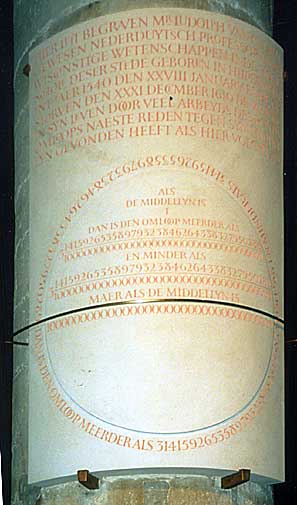
A passion for infinity by any means possible: Ludolph van Ceulen, a German from the 1500s living in the Netherlands, spent his life solving for the perimeter of a 4,611,686,018,427,387,904 (262) sided regular polygon. With some modifications to an equation from eighteen hundred years earlier he calculated π to 35 digits, more than doubling the accuracy of his contemporaries. It took a century for anyone to usurp his effort, which was engraved on his tombstone.

Tuesday, June 06, 2006

God is an Abstract Expressionist

In John Kotselas' book "Socrates in New York", God is referred to as the "Natural Artist" (as opposed to man, the "Artificial Artist", who simply imitates God's work). It's entertaining to read Norvig's classic "Artificial Intelligence: A Modern Approach" in light of that terminlogy:

...Most human learning takes place in the context of a good deal of background knowledge. Some psychologists and linguists claim that even newborn babies exhibit knowledge of the world. Whatever the truth of this claim, there is no doubt that prior knowledge can help enormously in learning. A physicist examining a stack of bubble-chamber photographs might be able to induce a theory positing the existence of a new particle of a certain mass and charge; but an art critic examining the same stack might learn nothing more than that the "artist" must be some sort of abstract expressionist.

Saturday, June 03, 2006

The Shadow of It

Timothy J. Keller once gave a lecture titled "The Significance of Tolkien". He discusses J.R.R. Tolkien's work and the origin of the various names and languages in the books. The following is somewhere between a quote and a paraphrase.

Everybody ... even his best friends (except Lewis) thought the Lord of the Rings was too bizarre. Many of you know, it flew completely against the canons of what you might call "modernist literature". When he wrote it, there was no category for it. Fantasy was essentially invented by Lord of the Rings. Here's my main thesis: he did not really write fantasy. Peter Jackson, the director of the films said, "You have to understand, Tolkien was not writing fantasy. He was writing mythology for the first time in centuries."

The basic inspiration for Tolkien's stuff was linguistic, which means he was not exactly making things up, but he was reconstructing a linguistic and imaginary past that could have existed. A person who is a pure fantasy writer just says "I'm thinking of a story and I'll make stuff up. There's a woman, what will I name her? I'll name her this, or that." That is not how Tolkien worked. He would get a name, and ask, "What does that mean? Where would that name have come from? What kind of person would have that name? What kind of story would that person have been in?" For example, he would be writing and up would come Faramir. He would not say "ok, what kind of character do I want Faramir to be?" he would say, "who is this guy? I need to find out."

He was rediscovering an imaginative world which is the root of all Northern European culture, thinking, and mind. There's reverberations of these words still in our heart. He was trying to ask... what was it that happened way way back, what experience, what being, what kingdom, so that even today we remember the shadow of it?

Tolkien said, there is a kind of very sad and yet very joyous story: you can call it a romance, you can call it an epic, a quest, you can call it even a fairy tale, that modern people said "we're past that now, we don't believe in hope we don't believe in good and evil." And Tolkien said, deep down inside we all need those stories. We need a story that tells us how bad things are, and we need a sudden turn in the story, that snatches victory from death and through suffering overcomes everything.

Saturday, March 18, 2006

The Essentialist Argument and Nature

One of the standard arguments against homosexuality goes: "It's contrary to our nature, considering there's no way to reproduce, so of course it's wrong." While one of the arguments in support of homosexuality goes "It's genetically determined, so it's part of our nature and it's right." (the essentialist argument).

What I find interesting is that they both use the same premise, "If something is natural, it is good." Whether homosexuality is genetically determined or not, the rebuttal against the pro-homosexual will normally include mention of the evils of other natural tendencies (like kleptomania). What the anti-homosexual doesn't realize is that they are undermining their own argument as well!

Sunday, March 05, 2006

Cast as Audience

Kierkegaard on life:

In the theater, the play is staged before an audience who are called theatergoers; but at the devotional address, God himself is present. In the most earnest sense, God is the critical theatergoer, who looks on to see how the lines are spoken and how they are listened to: hence here the customary audience is wanting. The speaker is then the prompter, and the listener stands openly before God. The listener, if I may say so, is the actor, who in all truth acts before God.
Sartre used the metaphor of an actor as well:
His movement is quick and forward, a little too precise, a little too rapid. He comes toward the patrons with a step a little too quick. He bends forward a little too eagerly; his voice, his eyes express an interest a little too solicitous for the order of the customer. Finally there he returns, trying to imitate in his walk the inflexible stiffness of some kind of automaton while carrying his tray with the recklessness of a tight-rope-walker by putting it in a perpetually unstable, perpetually broken equilibrium which he perpetually reestablishes by a light movement of the arm and hand. All his behavior seems to us a game. He applies himself to chaining his movements as if they were mechanisms, the one regulating the other, his gestures and even his voice seem to be mechanisms, he gives himself the quickness and pitiless rapidity of things. [...] He is playing, he is amusing himself. But what is he playing? We need not watch long before we can explain it; he is playing at being a waiter in a café.
As Sartre goes on to elucidate, the unbearable angst emergent from our ephemeral consciousness is often replaced by a "role" — an "act". What's more, as the guests respond to the waiter, he becomes more convinced of his personality (highschoolers demonstrate this principle perfectly — the outcast becomes more outcast, the bully more of a bully, the clown more of a clown...).

Perhaps Kierkegaard's actor and Sartre's actor aren't as different as they first appear: what if religion is a massive play, where everyone reminds each other of the "reality" of their role, and continues on, encouraged but deceived? How can you possibly tell the difference between the actor and the authentic?

There would have to be some sort of objective reality behind the actions of the individuals (after all, science would have this problem of inbred certanity as well if it wasn't for its attempt at objectivity). A Christian, for example, would have to be completely themself in a way the waiter is only attempting. I doubt you can resolve this in others, but might you answer for yourself?

The existential idea of angst could be approximated as a fear of potentiality. We take on roles to overcome that fear — by limiting our freedom we find a cheap imitation of security. We'd know, then, that we weren't acting (i.e., not deceving ourself and riding on the affirmations of others) if we had freedom without fear.

That's seems like an easy line to draw between naïve and realistic philosophies: there's hope in legalism and asceticism on one side (the denial of our "nature"), on the other, there's hope in the revelation of our true self.

(Note: Deriving the qualifications for our essence from Sartre's existentialism, which asserts that "existence precedes essence", is ridiculous. For the above conclusion to be coherent, we would have to reimagine his definition as something about coming to understand an essence previously unkown.)

Saturday, February 18, 2006

Computability, Ad Hominem, Faith and Reason

Consider the function:

Π(n) = { the position of the first occurrence of n consecutive zeros in the decimal expansion of π if it exists, 0 otherwise }
For example, "0" first occurs at position 32, so Π(1) = 32; the first few values are: 32, 307, 601, 13,390, 17,534... (according to the Pi-Searcher). This function is "computable" in a sense, for a trivial reason: for any given n, it is possible to output the correct integer (because it's possible to output any integer). But this function doesn't really teach us anything — it doesn't demonstrate a necessary relationship between the input and output values.

Now consider ad hominem, one of the most popular logical fallacies. In essence, it works by citing the origin of a belief as evidence against the belief. Sometimes it's just delicate slander, but other times the attack is on the argument itself. If I say "I'm alive because Andy Warhol walks among us.", you might respond "That's ridiculous, there is no relation between those two claims — and furthermore, Andy Warhol has most certainly kicked the can..." It's fine to argue with the soundness of my argument, but the problem lies in the conclusion of ad hominem: "...therefore, you are not alive." (a negation of my conclusion). This might sound silly, but it happens constantly. This would be as ludicrous as claiming that 32, 307, 601... could not possibly be the first three values for Π(n) simply because I haven't provided an algorithm associating those values with the function definition.

This all comes back to the question of where faith is justified. Imagine I've just given you 100 arguments for the existence of God. If you go through each one and explain why the argument is unsound, you haven't disproven God's existence (that would be a case of denying the antecedent — which Popper brings up when discussing falsifiability). Unfortunately, too many atheistic arguments are based on this fallacy. For example, Bertrand Russell employs one of the most subtle forms of ad hominem:
Religion is based, I think, primarily and mainly upon fear. It is partly the terror of the unknown and partly... the wish to feel that you have a kind of elder brother who will stand by you in all your troubles and disputes. Fear is the basis of the whole thing -- fear of the mysterious, fear of defeat, fear of death...
For another example, see this previous post.

In short, there's some interesting symmetries between computability, ad hominem, denying the antecedent, falsifiability and questions about the justification of beliefs... maybe it's just me, but I think symmetries help me see more clearly.