Showing posts with label thesis. Show all posts

Wednesday, January 20, 2010

Connected Everything

Here are some things I'm going to be covering in my thesis.

Friday, November 27, 2009

Defining Music, Again

I keep coming back to this issue (previously: Defining Music). Which is fitting, considering it's a large part of my thesis. I explained the basic idea to a friend recently in a way that seemed clear, so I'd like to preserve that clarity in text.

Before Ethnomusicology, western culture believed music to be universal amongst civilized peoples. Ethnomusicology helped people see that music was more local and less global. Around the same time, Cage encouraged people to hear things for themselves as music: saying that it is extremely local, to the point of being defined by an individual.

I would like to propose a reversal to Cage's position (or, at least, his language). I believe music is built out of correspondences between sounds and other things. Over time, these "other things" have been comprised of innate human impulses, society-specific tradition, and individual preference, in that order. I would like to add "everything else" to that category of "other things". This means that music exists without humans, as sounds always have context. Individuals do not decide what is music (this is the reversal), we can only decide what is noise. We do this by identifying acontextual sounds — and the context we use for understanding sounds is continually changing. Wind chimes ringing during a cool autumn walk have a different context to us than they do when we're trying to study next to them, or trying to hear past them.

As context-creators, of the general category of conscious non-omniscient beings, we define music only insomuch as we misunderstand some of it as noise.

Tuesday, August 18, 2009

The Negativity of Noise

In "Noise", Jacques Attali proposes that noise is a simulacrum of murder.

We must establish two things: First, that noise is violence: it disturbs. To make noise is to interrupt a transmission, to disconnect, to kill. It is a simulacrum of murder. Second, that music is a channelization of noise, and therefore a simulacrum of the sacrifice. (p 26)

He goes on to provide a technical description for the uninitiated:

A noise is a resonance that interferes with the audition of a message in the process of emission. A resonance is a set of simultaneous, pure sounds of determined frequency and differing intensity. Noise, then, does not exist in itself, but only in relation to the system within which it is inscribed: emitter, transmitter, receiver. Information theory uses the concept of noise (or rather, metonymy) in a more general way: noise is the term for a signal that interferes with the reception of a message by a receiver, even if the interfering signal itself has a meaning for that receiver. Long before it was given this theoretical expression, noise had always been experienced as destruction, disorder, dirt, pollution, an aggression against the code-structuring messages. In all cultures, it is associated with the idea of the weapon, blasphemy, plague. (p 26-27)

I can't deny that there are technical definitions of noise that restrict it to the "undesired portion" of a signal. And I completely understand that a variety of cultures see noises as violent. And that we have an intuitive reaction to them as violent.

But saying that noise "does not exist in itself", and advancing the technical definitions or intuitive folk-definitions as the final word on noise seems narrow minded to me. What about noise in an epistemological context, as a human creation: without humans, there is not only no music, but no noise. It's not that noise requires music in order to be differentiated, but it requires humans to do the differentiation. This act of sound-interpretation and categorization is equally important as our technical and folk definitions.

Furthermore, I reject language like this:

In its biological reality, noise is a source of pain. Beyond a certain limit, it becomes an immaterial weapon of death. The ear, which transforms sound signals into electric impulses addressed to the brain, can be damaged, and even destroyed, when the frequency of a sound exceeds 20,000 hertz, or when its intensity exceeds 80 decibels. Diminished intellectual capacity, accelerated respiration and heartbeat, hypertension, slowed digestion, neurosis, altered diction: these are the consequences of excessive sound in the environment.

I reject it because it's conflating two very different phenomena: noise, and damaging sound. Saying that noise is a source of pain, and then giving examples of loud sounds and high pitched sounds is just giving noise a bad name by association. If I play a Bach chorale at 80 decibels, it's going to do just as much damage as "noise".

Ignoring Africa

I'm always a little surprised when I read things like this:

All music can be defined as noise given form according to a code (in other words, according to rules of arrangement and laws of succession, in a limited space, a space of sounds) that is theoretically knowable by the listener. Listening to music is to receive a message. Nevertheless, music cannot be equated with a language. Quite unlike the words of a language — which refer to a signified — music, though it has a precise operationality, never has a stable reference to a code of the linguistic type. Itis not "a myth coded in sounds instead of words," but rather a "language without meaning." It has neither meaning nor finality. (Noise by Jacques Attali, p 25)

Monday, August 17, 2009

Pranks and Pragmatism

Some excerpts from "African Rhythm and African Sensibility" by John Miller Chernoff.

African drumming is renowned for the ability to express the tonal structure of their spoken languages, to the point where rhythms are imbued with complex semantics. A great illustration:

During my first day practicing with Gideon, I was following him well until he suddenly performed a rather complicated series of rhythms and then went back to the basic rhythm he was showing me. A few minutes later a man who passed at that moment returned with two bottles of beer. (p 75)

There is a short passage discussing the difference between "false meaning" and "intended meaning", due to a prank:

Ibrahim Abdulai's son Alhassan, who was assisting in my instruction displayedgreat ingenuity duringan extended prank in which he tried to confude me in my work by inventing false meanings to fit many rhythms in Takai [a dance/beat from the Dagomba in northern Ghana]. Many of the rhythmic styles a Takai drummer beats are played only to make the music more interesting, but the language Alhassan supplied matched the rhythms so perfectly that I began to think Ibrahim was withholding the meanings. When I persisted in my questions, he said, "We have a general name for the whole Takai drumming, but only a few of the rhythms have names. In Zhem [another Dagomba dance/beat, played "during the "installation or funeral of high chiefs"], all the drummers will be making speeches, but in Takai the rhythms are mainly to make the dancers strong. The name given Takai is for the different rhythms combined together, and all the rhythms are equal. Anyone who wants to tell you words for these rhythms is lying. Anytime I want, I can just listen to the sound of the dondon [an hourglass-shaped talking drum] or gondon [sic? "gongon"] and compare the music to something in the Dagbani language [of the Dagomba], but it is not the same as making speeches. As for the styles you have been learning, I am the one who has been bringing all these styles when drumming Takai, and I am the right person to give them meaning, but I have no name for them. So how can another person give them meaning or say that this style says this or that style says that while I was not making speeches when I got those very styles?" (p 76)

Another example is given of a "false meaning" for a dance, Bangumanga, that is regularly accepted by "junior players":

The drum language is Bem bo ma, be pam boma je ("They will search for me, but they will not see me"). One false meaning is Man daa yeli, mam bi lan yeli ("I said it; I don't say it again"). The meaning is a "secret" because of the seriousness of the war. In its truth, Bangumanga recalls the blood that was shed in the war... (p 206)

Sometimes the meaning of rhythms is simple misunderstood.

If you play gagedega instead of gagedegi when executing a phrase on Atsimewu [a tall drum that acts as a lead], or if you miss the pitch when beating a dondon, you may have a more serious mistake than you think. Indeed, one of the reasons why repetition is so important in African music is that repetition of a rhythm often serves to clarify its meaning. When rhythms change too abruptly, the music can lose some of its meaning... (p 80-81)

This tendency to court misinterpretation can be heard just by listening to the complex polyrhythms of any West African dance:

The effect of polymetric music is as if the different rhythms were competing for our attention. No sooner do we grasp one rhythm than we lose track of it and hear another. In something like Adzogbo or Zhe, it is not easy to find any constant beat at all. The Western conception of a main beat or pulse seems to disappear, and a Westerner who cannot appreciate the rhythmic complications and who maintains his habitual listening orientation quite simply gets lost. [...] Actually, if we try to apply Western notions of bars and time signatures, the music seems much more complicated than it really is. [...] The individual rhythms are simple, but the way they are combined can be confusing to Westerners. (p 46-47)
I see these stories as beautiful metaphors for, and examples of:
  • Information having a noisy character (the beer story)
  • The difference between intention in sending and receiving
  • Our ability to find structures that have a different cause than we expect
  • Repetition as the foundation of meaning, a type of contextualization that allows us to separate "signal" from noise
  • The interaction of repetitions producing more complex structures than the sum of their parts (in the case of polyrhythms, it's their least common multiple)
  • Our ability to misunderstand a system based on the wrong contextualization (the last example of Westerners misunderstanding polyrhythms)
  • Combinatorial music in general

Tuesday, August 11, 2009

Stars and Bubbles

Astronomers have recently realized that galaxies are distributed in a sort of "frothy" or "bubbly" structure. That is, the large scale structure of the universe can be described as consisting of strings of galaxies with big spaces in between.

A projection of this structure onto the sky of any planet should look highly web-like as well. From these webs, we've created constellations. One of the features that has helped give rise to similar constellations from separate traditions is locality: 參, the ancient "three stars" asterism from Chinese astrology, matched the belt of the Greek constellation Orion. Within traditions, "guideposts" are also established, creating a coherency to the stellar structures.

Various religious traditions have identified constellations as prophetically or genetically relevant to their beliefs. In 1884, Joseph Seiss laid out his "Gospel In The Stars" system, describing the relevance of the zodiac to Christianity. Authors like John Kotselas will argue that the structures act to justify belief in Christianity. Today, new patterns are identified and the old ones still argued.

Thursday, July 23, 2009

Signals and SETI@home

SETI@home is a distributed computing project scanning the sky for radio transmissions that bear traces of extra terrestrial intelligence. They define a "signal" as:

  • Spikes in power spectra
  • Gaussian rises and falls in transmission power
  • Triplets (three power spikes in a row)
  • Pulsing signals
Some of these are domain specific (Gaussian rises and falls are due to the telescope passing over a signal source), while others can be generalized. For example, triplets represent a kind of repetition. When you have two of something, there is ambiguity about whether it is chance or not. You can always fit a line to two data points. When there are three events, you can measure the similarity of the two intervals, and make at least three comparisons. Pulsing signals represent another kind of macroscopic repetition. There are really just two types of features: general (repetition), and domain specific (power spikes, Gaussian rises and falls).

Friday, June 12, 2009

God's Geography

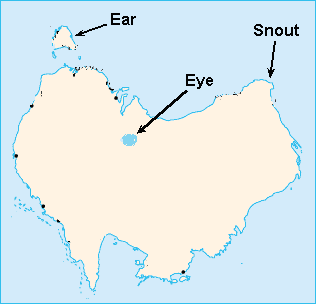
Clouds are perhaps the most timeless noise source ripe for induction, but with the advent of accurate mapmaking and satellite photography we can look to geography as well.

From God's Geography:

Spiritually speaking, the Australian dog doesn't have eyes to see or ears to hear (Isaiah 6:9-10). Additionally, most of Australia's interior is desert or outback, so this dog's head doesn't have much for a brain either.

Also see The Afro-Latinosaurus Rex

Wednesday, May 27, 2009

Strange Loops

Hofstadter's strange loops are a very accessible subset of coherentism. I say "subset" because self-reference, at first glance, seems to be a only one type of reference. This is only true if you make claims from a perspective. If you make non-perspectival claims, there is only self-reference (meaning is only established recursively).

Saturday, May 23, 2009

Helter Skelter

Charles Manson had an intricate interpretation of Revelations 9 that predicted he was the returning Jesus Christ, and that the Beatles were somehow involved in the coming apocalypse. From Wikipedia:

Verse 17: "And thus I saw the horses in the vision, and them that sat on them, having breastplates of fire, and of jacinth, and brimstone: and the heads of the horses were as the heads of lions; and out of their mouths issued fire and smoke and brimstone."
breastplates of fire = the Beatles' electric guitars
fire and smoke and brimstone out of their mouths = the Beatles' powerful lyrics, the power of their music to ignite Helter Skelter
A reminder that some more ambiguous prophetic texts are notoriously difficult to discuss in a non-coherentist manner.

Thursday, May 21, 2009

Positively Divine Understanding

From the Wikipedia article on the Japanese painter Hokusai, some thoughts on understanding and sharing the natural world:

"From around the age of six, I had the habit of sketching from life. I became an artist, and from fifty on began producing works that won some reputation, but nothing I did before the age of seventy was worthy of attention. At seventy-three, I began to grasp the structures of birds and beasts, insects and fish, and of the way plants grow. If I go on trying, I will surely understand them still better by the time I am eighty-six, so that by ninety I will have penetrated to their essential nature. At one hundred, I may well have a positively divine understanding of them, while at one hundred and thirty, forty, or more I will have reached the stage where every dot and every stroke I paint will be alive. May Heaven, that grants long life, give me the chance to prove that this is no lie."

Monday, May 18, 2009

MOOKDFJLAL

Take a photograph in your bedroom with a pillow on your head. Upload this photo to the internet (like on Flickr). Tag the file with: MOOKDFJLAL. When you search for MOOKDFJLAL you will find photographs of people wearing pillows on their head. David Horvitz, May 18, 2009
If you search for 241543903, you'll find another Horvitz creation ("people putting their head in the freezer."). It's been called a "meme", but I feel like that's a secondary characteristic of this entity. Memes have origins you can point to and say, "There, look at that — isn't it funny? That's why everybody's been copying it." But 241543903 and MOOKDFJLAL exist primarily because of the photos, not because of David's original instructions. This is coherentism in action.

Thursday, May 14, 2009

Aaron Koblin Interview

Aaron Koblin discussing Processing, and "Flight Patterns":

I remember the first day that I looked at the data. Within about fifteen minutes I went from cryptic numbers and letters to easily recognizable patterns. It was a thrilling experience.